
The Lie Machine Replacing British Politics
Managerial government creates an emotional vacuum that social media fills with grievance, propaganda and tribal certainty. It's time to take The Sniff Test.

A New Narrative Energy
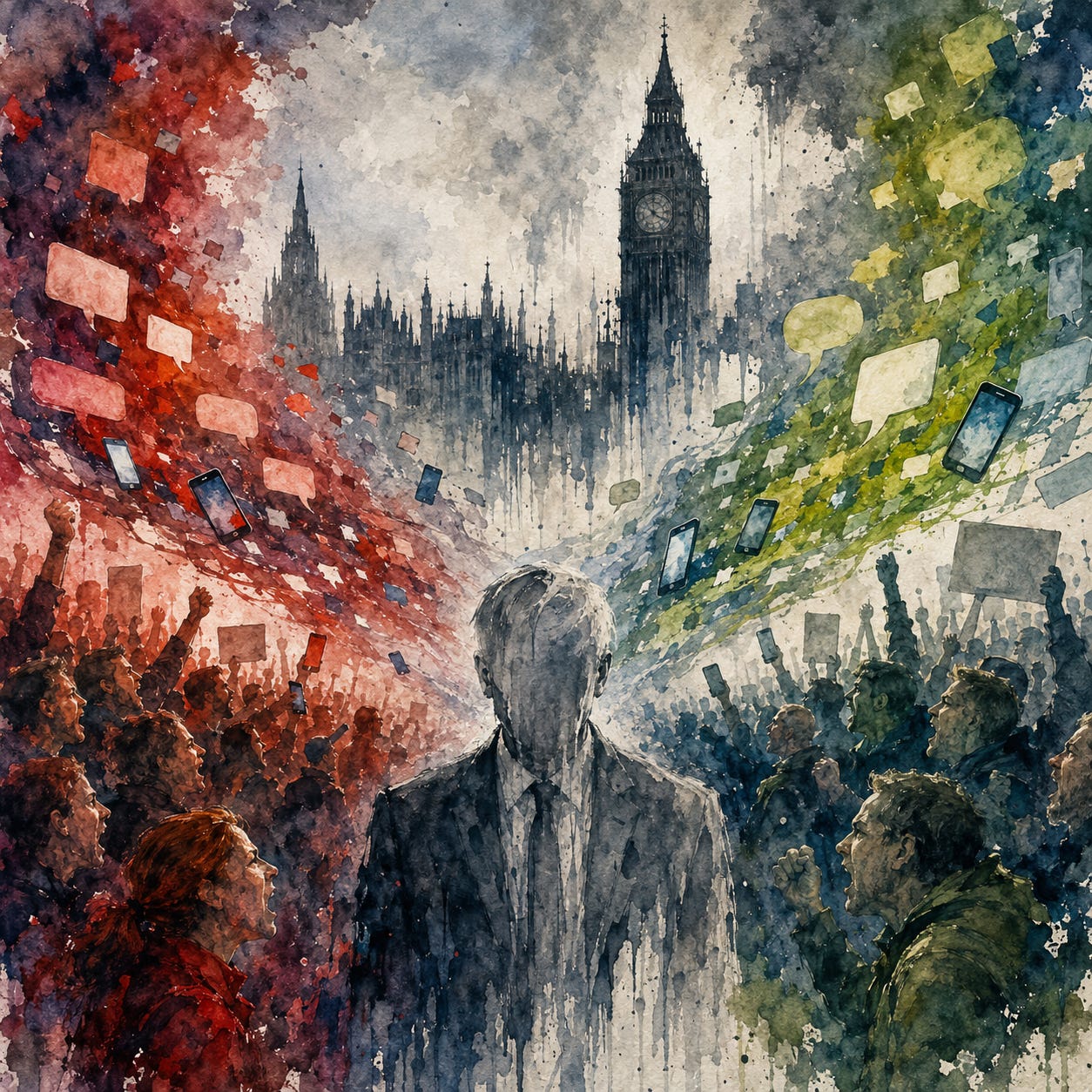
Politics changed when the Cold War ended. Ideological leadership asserting the primacy of Western liberal values gave way to creeping managerialism. Political parties organised around technocratic competence and, in so doing, distanced themselves from the daily struggles of their supporters. The resulting emotional vacuum at the centre of politics was vulnerable to manipulation. Then along came social media.
Ideology fragmented rather than disappeared. Nationalism, environmentalism, identity politics and Islamism compete for the same space, even when not in direct competition with each other. This has produced a new political environment where narrative strength triumphs over intellectual honesty. It produces a political playbook of denial, downplaying and distraction.
The Rise of Managerial Politics
Baroness Fox is a non-affiliated life peer and fierce advocate of free speech. A former Trotskyist turned libertarian, she supported Brexit and was elevated to the Lords despite previous opposition to its existence. She founded the Battle of Ideas, which I attended last year.
Fox explains the end of two-party politics on The Brink podcast. With the Cold War won, politicians shifted gears. Blair and Brown abandoned a traditional class-based ideology and positioned New Labour as a party of government. Cameron and Osborne took up the mantle, preaching austerity to their party, while increasing the size of the state year after year.
The subsequent revolving door of prime ministers has struggled to define an identity for Britain outside of the EU. The civil service seems incapable of operating without directives from Brussels. British politics became middle management, implementing instructions from special advisors and international institutions, while lacking in leadership.
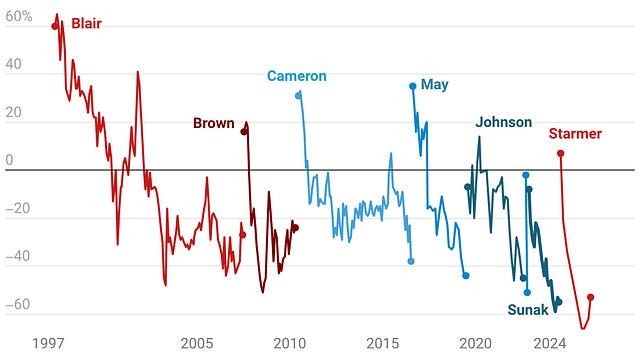
Fox’s most powerful point is that politicians became disdainful of their electorates. Without the clear and common purpose of Cold War politics, managers saw themselves as superior, as they handed out instructions. But disdain cuts both ways. The speed with which support for prime ministers falls is accelerating. Starmer is as much a victim of this as its cause.
The end of the two-party system offers an opportunity for a new style of politics. This unites supporters around a cause, without much pretence of governing for the population at large. It is emotional and adversarial politics.
Fraser Nelson points to his native Scotland to show how politicians with a cause can ride out scandal. A history of nefarious goings-on has not derailed 19 years of SNP government. By the end of the current parliament, Scotland will have been a one-party state for longer than Viktor Orban’s Hungary. Such is the strength of the nationalist cause.
The weapon of choice for this new politics is social media and its ammunition is deny, downplay and distract.
The Lie and Its Aftermath
The dissolution of the Cold War enabled a nuanced view of Western history to evolve. There was no longer a black-and-white presentation of good guys and bad guys. Environmentalism, de-colonialism and identity politics are all reactions to the single story we used to tell ourselves. These movements began on the fringes of politics and the parties are still grappling with how to react or incorporate them.
The new causes are no more straightforward than the old story of evil Soviets and virtuous Westerners. They are, however, presented as stark truths. This necessitates the lie, which is to deny any evidence that contradicts your position.
Ed Miliband is among the first politicians of the managerial era to cross over into the new style. He repeats his truth that the UK’s energy costs are a direct result of global oil prices. He flatly denies that his taxes distort the market. A simple thought exercise illustrates this falsehood.
There is no global oil price. There are multiple grades of oil, and the price of each is determined by the availability of supply and the urgency with which it is needed. But imagine there was one, single price. If this were the only thing to determine the cost of electricity, then the price would be the same the world over. It is not.
Britain has among the world’s most expensive electricity. Local factors such as the cost of buildings, transport, and labour impact what we pay for things. But so do the taxes loaded on commodities and the companies that produce them. The UK has taxes that other countries do not. We also have higher energy prices.
Eventually the lie is exposed enough to force a reaction. This leads to phase two of the playbook, which is to downplay. An accusation can be recognised, but its significance dismissed.
Nelson continues his theme with reference to Farage, arguing that a strong cause can make supporters more forgiving of corruption. Farage accepted a £5 million personal gift from a crypto billionaire, but stressed it was for private security. He then invested in Kwasi Kwarteng’s crypto venture and his partner, a former waitress, bought a house for cash. Nelson claims that Reform is a company rather than a political party. Farage replies that “It’s my money, I’ll spend it how I want.” In other words, nothing to see here, folks.
When a scandal becomes big enough to matter there is a third part of the playbook. This is to accuse your accusers of not taking your attempts to clean up seriously. The clean-up is the distraction.
The best example of this is the government inquiry. Starmer was Director of Public Prosecutions at the height of the grooming gangs scandal. His office declined to press charges on networks of paedophiles exposed in Rochdale and Rotherham. The issue is once more live after a national audit identified systematic and repeated failures by authorities. Starmer’s response is a three-year inquiry, taking us to the eve of the next election.
This obfuscation was harder in the direct confrontation of the two-party politics of the past. But today’s politicians have abandoned argument in favour of soundbites. MPs in parliament and on television focus on generating meme-worthy video clips. The old game was to convince people with the strength of your argument. The new game is the emotional mobilisation of your supporters. The playing field is social media.
The Rise of Antisemitism
Social media rewards emotional narratives that propaganda ecosystems may exploit. Palestinian activism is the clearest demonstration of this.
Propaganda amplifies and radicalises genuine grievances. The suffering of Gaza’s civilians provides an obvious emotional foundation. A deliberate campaign can turn moral outrage into radical opposition to Israel through ideological identity, peer reinforcement and a calculated mixture of truth and lies.
Warren Kinsella lays this out in The Hidden Hand: The Information War and the Rise of Antisemitic Propaganda. Information wars are as important as military conflict. October 7 was a surprise attack on Israel, but Kinsella claims it also unleashed a premeditated social media campaign, designed to delegitimise Israel and normalise hostility towards Jews.
Kinsella’s observations are compelling. Eight million people saw claims that Hamas was responding to an attack on Arabs praying at the Al-Aqsa Mosque. No such attack occurred. A post in pidgin English pictured a captured mother clutching her young boys. The caption beseeched Palestinian soldiers to spare them as “we are people of humanity”. This sought to downplay the reality of kidnapping. All three family members were strangled.
Five days after the attack, a verified X account claimed the US and Israelis were lying about rapes and beheadings. They were accused of racism and Islamophobia. Tens of thousands liked a post that served as a distraction.
Hamas maintains a 160-strong propaganda team with 1.2 million followers. They magnify the messages, which are posted in forums with another 25 million members. This advanced strategy to flood social media caught Israel cold in its confused and contradictory response.
Hamas has a cause, a consistent narrative, and powerful emotional appeal. The cause is a Palestinian state. The narrative is an underdog resisting a far superior force. The emotion is driven by falsehoods and fake imagery, intermingled with enough reality to retain credibility.
Success also depends on the volume of output. Flooding internet channels maximises reach and crowds out the counternarrative. The political consequences of mass reproduction were anticipated decades ago.
The Collapse of Mediating Organisations
Mass reproduction destroys scarcity. This is as true in art as it is in politics. Walter Benjamin illustrated this during the 1930s, in The Work of Art in the Age of Mechanical Reproduction.
A Picasso retains its value because it is unique. Meanwhile art is everywhere, with AI slop on social media just the latest use of technology to commoditise content. The result is a squeezed middle. Where once there was a community artist, a portrait photographer, or a local news reporter, we have digital art, iPhones, and a handful of global media brands.
Benjamin argued that it is the means of reproduction that democratises and devalues art. Volume plays a critical role. Technology allows messages to be copied at scale. Social media is mass manufacturing of opinion. It destroys the mediating institutions that once filtered, contextualised and slowed political narratives.
Sheer volume overwhelms moderating voices. It demands attention, turning local elections into platforms for posturing on national or international issues. Politics becomes polarised between elite spectacle and mass noise.
The question is whether this campaigning style of politics transfers into effective government. Outside of immigration, Reform UK offers only me-too policies. The spine of the Green Party was environmentalism, but its activist energy is being pulled towards anti-Israel radicalism. A cause may bring either of them to prominence and even power, but it says nothing about the competence required to run a country.
That is a question for another day. Right now, the incentive is to play on the us-against-them nature of campaigning. This rewards the use of outrage and spectacle. Strength of character is exhibited by the ability to ride out criticism, rather than to debate and compromise. The soundbite leaves no room for nuance and our politics is poorer as a result.
The Importance of Emotion
Politics has shifted from competence to narrative warfare. The two-party politicians are wise to this, but the firebrands on their flanks have a significant head start. In their world, truth is secondary to identity and mobilisation.
Managerial politics fails because it lacks emotional legitimacy. It replaced the us-versus-them narrative of the Cold War with grey-suited nothingness. It was only a matter of time before a confrontational style re-emerged.
The new politics is based around social media. This rewards those capable of appealing to identity, grievance and cause. Deny, downplay and distract became the framework for a political class scrabbling for authority, in an environment where trust has collapsed.
Related Reading

Sources
Claire Fox on The Brink, May 2026
Nigel Farage and ‘moral license’ - Fraser Nelson, May 2026
The Work of Knowledge in the Age of AI Reproduction - Rex Woodbury, May 2026
You know now why I stopped writing about British politics. It simply became too disgusting/depressing.