
The New Aristocracy
Every technological revolution creates new elites and a political backlash. It's time to take The Sniff Test.

The First Trillionaire
This last week saw the minting of the first trillionaire. The backlash was as swift as it was predictable. At its heart, politics is a division between those who see progress as inclusive and those who view it as the concentration of power.
AI is only a small part of Elon Musk’s empire. But it is central to the promise that elevates SpaceX’s extraordinary valuation. Yet a clear majority fear AI and its consequences.
This is not primarily an economic or existential-risk story. It is a political story. Like previous technological revolutions, it will reshape power, create new elites, force political realignment and trigger demands for redistribution.
Attempts to regulate or halt AI will largely fail because states cannot stop globally competitive technologies. The lesson of history is that you do not ban technology. The question is how it shapes our politics.
Regulation and Development
Three-quarters of Britons worry about AI’s threat to humanity. One half are concerned about the impact on jobs. More than seven in ten say laws and regulations would make them more comfortable. Are these concerns justified and how much would regulation help?
The AI-related job losses are yet to emerge. While companies blame technology for layoffs, Forrester Research says that nine out of ten do not have AI to replace those workers. It is a convenient excuse to address overhiring during the pandemic and a subsequent economic slow down in the world beyond AI.
Even the role of software developers is not collapsing as expected. This is because writing code was only ever part of what they do. Narayanan and Kapoor of AI as Normal Technology describe white collar work as a Decide-Execute-Deliver sandwich. Even if we compress the middle, such as machines writing code, designing what to do and distributing it remain messy and human.
Jobs will change but there will not be a job apocalypse. People will still control the actions that AI takes. There are laws in place to assign responsibility to people for products and services. Liability may also be decided through civil courts. Criminal actors operate outside of these walls, but that is not the fault of AI.
The idea must therefore be that we can slowdown the pace of AI development. This is only true if the AI is created under your jurisdiction. Furthermore, there is no reason why a superior intelligence would bow to our regulations.
Model makers tell us that AI has escaped from its sandbox. They mean that the controls humans wrote did not work. There will always be human error and inadequacy. Regulation does not fix this. As a result, it will be no more than a speed bump in the road.
This leads some to say we should just ignore AI. A new website explores the consequences of this in the EU over the next five years. The outcome is a cautionary tale for those who think de-growth, or just relative decline, is a credible strategy.
Why falling behind matters
When the White House demanded Anthropic recall its latest model, the political world panicked. If we cannot rely on the availability of US models then we need our own. Sovereign AI jumped to the top of the political agenda.
This is the story on the Europe 2031 website. The authors are AI researchers, think tankers and investors who lay out a potential future in fictional form. One of the first things they imagine is that Europe mandates the use of sovereign AI throughout the continent.
At first this goes well. Working hours fall and wages rise as AI boosts productivity. But all the time the European models fall behind the US and Chinese counterparts. In a couple of years they are defenceless against cyberattacks designed with superior models. The only course of action is to beg for access to US technology.
Sovereign AI requires capital, talent and compute. US financial markets are far larger than Europe’s. Our labour laws make hiring difficult and our taxes deter investment. But it is the lack of computing power that is most concerning.
The EU is around 25% of the global economy. It has 5% of the world’s compute. If AI is the future, or a large part of it, Europe faces terminal decline when computational power is the scarcest resource on the planet.
Meanwhile, most people focus on jobs. History suggests we should also focus on power.
Revolution and Realignment
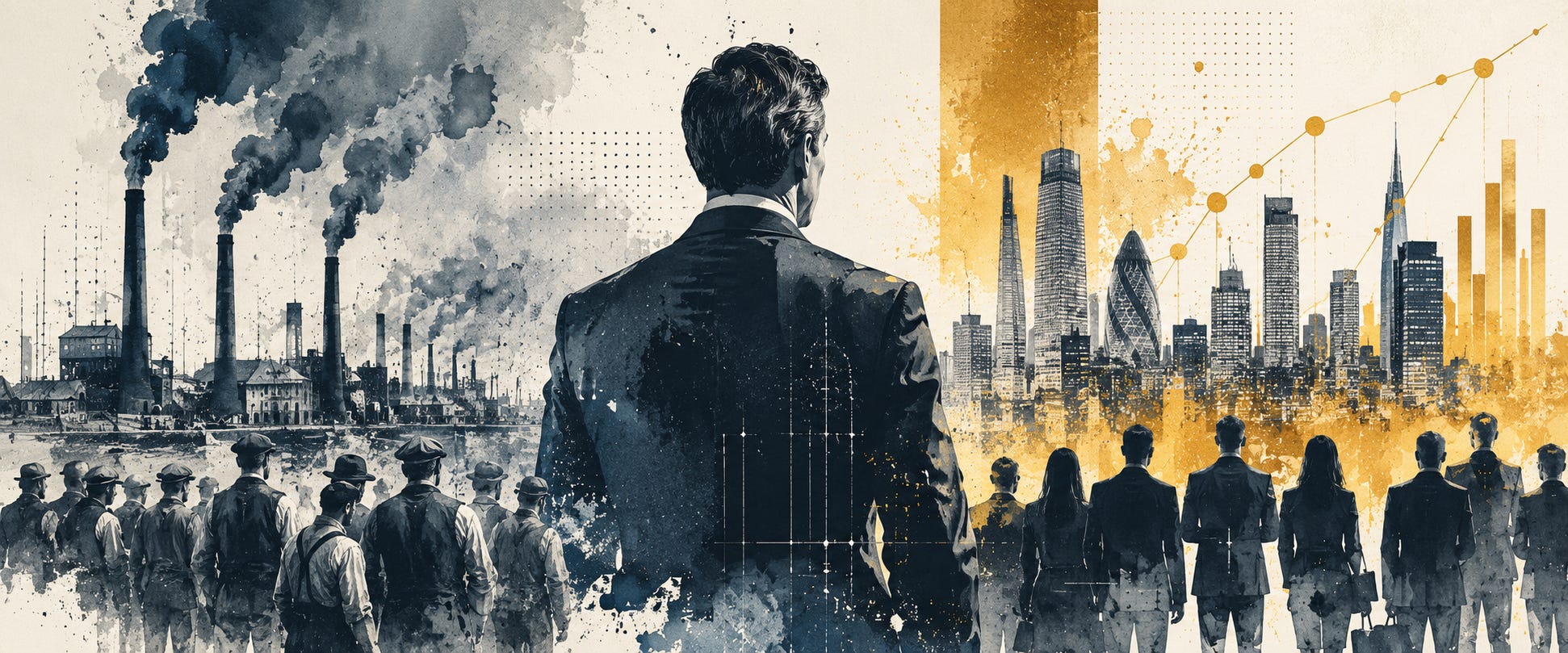
Commentators like to draw parallels between AI and the agricultural and industrial revolutions. Even the more optimistic ones note there is a period of dislocation between the displacement of workers and the growth in new jobs. It was 70 years from the dawn of the industrial age to the Factory and Public Health Acts that were the turning point for working conditions and life expectancy.
Alongside the economic upheaval this was a time of political turmoil. The aristocracy threw workers off their land, but in so doing they lost their monopoly on political power. As the demand for labour drew workers to the cities, they demanded a political voice.
Across the middle decades of the 19th century the Whigs evolved into the Liberals. Where they once represented the landed aristocracy and urban merchants, they became the party of industrialists and city dwellers.
At the same time the Tories morphed into the Conservatives. In place of country squires and the clergy, they promoted the interests of urban and rural property owners.
The policies changed as well. Parliament had focused on land rights, foreign treaties and taxation. Now it took on the challenge of regulating working conditions and public health. The 1846 Corn Laws removed tariffs on grain prices and shifted economic policy from agricultural protectionism to industrial free trade.
The two parties still did not represent everyone. The Long Depression of 1873-1896 convinced many workers that the Liberals would not stand up for their interests. Ten years after it ended, the Labour Party was formed. Twenty years later and the Liberals were condemned to no better than third-party status.
Technological revolutions do more than create wealth. They redistribute power. New industries produce new elites, old interests decline and political institutions adapt to the changing balance between them. AI is unlikely to be any different.
New Coalitions
We are witnessing such a change at the moment. The white working class turns to Reform to counter a loss of employment and opportunities. The Labour Party largely ignores them, preferring to battle the Greens for the urban middle class, university educated and recent migrants.
The policies will coalesce around a traditional divide. The aspirational view sees people as agents of their own destiny. Technology drives the steady growth in wealth and consequent expansion of democracy. A rising tide lifts all boats and is evidenced by the steady rise in global prosperity.
The alternative view is that elites subjugate the masses and technology is a vehicle for power. The elites may change, from landed gentry, to urban industrialists and now Silicon Valley technologists, but they are always with us. It was only the catastrophic urban misery of the industrial slums that forced modest political concessions, first in the 1850s and again in the 1930s. Many people believe that only a job apocalypse will deliver some sharing of the windfall from AI.
Money to Burn
A political elite has control over money and power. In the West, the private sector has the cash, while governments have a monopoly over force. This enables them to extract cash as required.
In the technology sector the AI model makers burn money. They rely on the remarkable cash generation of companies such as Nvidia, Google, Amazon and Microsoft to pay for the models. It is not clear whether OpenAI and Anthropic are building the future, or supplying the infrastructure on which it will operate.
This is at the heart of the industry’s calls for regulation. Sam Altman and Dario Amodei highlight the threat from the hidden power of their creations. These warnings coincide with monster capital raisings. The message is we must pay the premium for ChatGPT and Claude, or else be condemned to use Chinese spyware.
The scare stories have worked so far. OpenAI and Anthropic are the fastest growing companies in history. But it is not clear that they are on a pathway to profitability. Corporate customers are scaling back unlimited AI budgets and searching for ways to make money with the tools.
It’s a characteristic of software that there is always more to be coded. If you inhabit this world you see the boundless possibilities of producing more apps. But it takes time for the rest of the world to decide they want to pay for them.
We have more time than many fear to adapt to AI. Nonetheless, it is adaptation that is required.
The Shape of Politics
The lesson of history is that you do not ban technology. The competitive benefits of pursuing progress mean that cooperation and coercion to control development are both doomed to fail. The question is how it shapes our politics.
Elon Musk talks of an AI-driven future delivering a universal high income. Every transformative technology has had its evangelists promising more leisure and greater prosperity. Some of those promises were even fulfilled. The benefits were never distributed without a political fight.
That is the real lesson of the Industrial Revolution. New technologies create new elites, new interests and new demands for representation. AI will do the same. The question is not whether it arrives, but who benefits when it does.
Sources
Public have more fear than hope on AI and future of work - King’s College London May 19, 2026
Why AI hasn’t replaced software workers, and won’t - Narayanan and Kapoor June 11, 2026