
The Stories That Shape Us
The future belongs to the people who can imagine something better. It's time to take The Sniff Test.

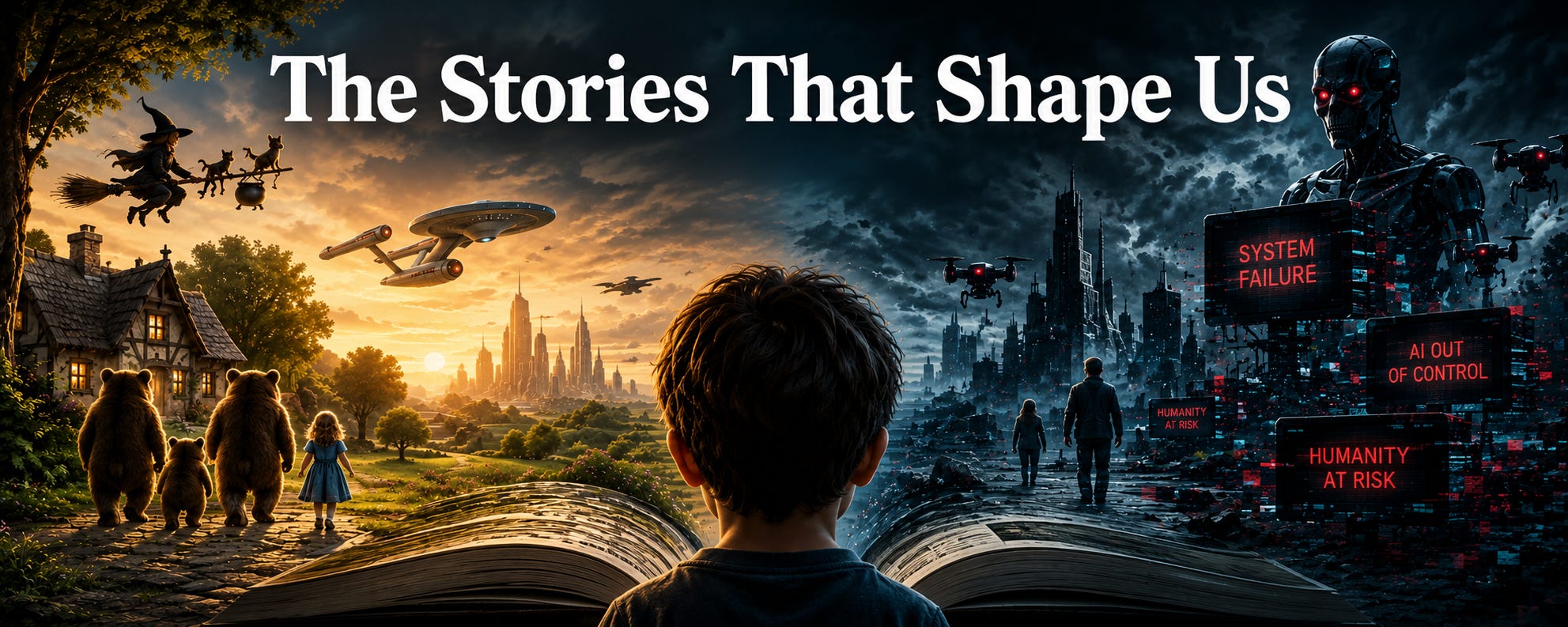
The Next Generation
What were your favourite childhood tales? What stories did you share with your children? You can be sure they remember them and have absorbed the messages.
My favourite was Goldilocks and the Three Bears. It teaches us that actions have consequences and to lock your front door. This may be why I am more cautious than carefree.
My daughters enjoyed The Tiger Who Came to Tea and Room on the Broom. They are books about inclusion and, in the latter case, community and teamwork. If the girls took these values to heart, then all is well.
Politicians tell stories. Personal narrative and private values inform their public policies. Andy Burnham is a northern working class lad, all footie and indie music, infused with social justice by his Catholic upbringing. As a result we will have devolution, collective ownership and £2 bus fares.
Influencers tell stories. Companies create them for brands. But the stories we tell children are the most important. Their developing minds are the most susceptible to indoctrination. Today, the stories we tell them are overwhelmingly negative.
A New View of the World
The Future Vision XPRIZE is offering $3.5 million to filmmakers. Applicants submit a 3-minute teaser, a written outline known as a treatment and, if chosen as a finalist, a draft script. The prize proposer, Peter Diamandis, is seeking a hopeful, compelling and optimistic vision of humanity’s technology-filled future.
Diamandis loves Star Trek. He tells how the first cell phone call was made by an engineer who wanted to build the device he’d watched Captain Kirk use to call the Enterprise. Dr. McCoy’s handheld medical scanner came to life in 2017 after another XPRIZE challenged over 300 teams to make one.
But Diamandis is troubled by how most science fiction paints a desperate and dystopian vision of the future. Technology is the enemy. He cites Terminator, the Matrix, Blade Runner, Black Mirror, Ex Machina and Ready Player One. Children watching them are being brainwashed into believing that technology will subjugate and possibly kill them.
Diamandis is a champion of new technology and AI in particular. His Moonshots podcast is unashamedly optimistic on every new development. Its vision of an abundant future powered by AI is increasingly at odds with the people who run the model makers.
Anthropic and OpenAI are in a bind. Their models are expensive to run and yet easily copied by Chinese competitors offering cheaper versions within weeks. Questions are being raised about their business model and financing needs. The superiority of US AI models is at stake.
Faced with this reality, senior executives tell tales about the terrible potential of AI. Imagine if this got into the wrong hands. This will happen if US companies continue to use Chinese models. The government must rescue us from the edge of apocalypse.
This creates a novel situation. Those building the technology warn those who don’t use it that it is incredibly dangerous. Meanwhile, Anthropic’s users tell them Claude is unreliable, not that it is a threat to humanity. The public swallows the fearmongering whole, because of the tales we were told.
Think about the stories we remember from school. Archimedes discovers density because his bath overflows. Newton discovers gravity when an apple falls on his head. We are conditioned to believe that knowledge appears like magic. If that’s how we imagine discovery, it’s hardly surprising we are persuaded that machines will suddenly become evil superhumans.
Except they won’t. AI has already memorised all recorded human knowledge. Yet it has not come up with any life-changing, let alone life-threatening inventions.
A better story would be how humans make significant breakthroughs working with AI. This is far more likely to be an accurate prediction of the future. If you are handing over work to an unreliable machine then you are going to be disappointed. If you are collaborating with a creative partner, then its random thinking could be just what you need.
A new series of stories is required to teach us to see the world this way.
A Tale Worth Telling
The threat from AI is only one of the many disasters we tell tales about. Nuclear war and environmental collapse make for popular films. The warnings make their way into the classroom.
Young children are taught that people are killing the planet. History is reinterpreted using today’s values. Erstwhile heroes are repainted as racist, misogynist, homophobic and capitalist.
The greater sin is what children are told to do about this. They learn about boycotts, protests and reducing consumption. They should be taught how they can make a real difference. Rather than pretending being vegan stops cows farting, inspire them to invent a semiconductor that uses a fraction of the current electricity requirement.
Science is cool. Science solves problems. Science should be what children are inspired to want. Too often the tales they are told and the teaching they receive leave them feeling that science is the enemy. Why is this?
Agnes Callard blames the uni-context. This is the system of universal values that we abide by in every situation. It is a result of technology.
When we lived in villages, we knew how to behave in church, in the pub and at home. There was a context to each. They were different.
When newspapers came along, we were exposed to a world that changed every day. The important stuff happened outside of the village. There was a set of values that existed beyond those we knew, which appeared vibrant and important.
This impression intensified with radio and television. It reached extremes with always-on social media. Wherever we are, we reach for our phones and are instantly transported to the uni-context.
Callard’s critical observation is that the binding values in this world are likely to be negative. Take the simple example of food. I like steak, you like salad and our colleague is a pescatarian. We have no shared idea of good food or a great meal.
We can, however, agree that environmental destruction, racism and genocide are bad. We might want to discuss the causes and uncover some nuance, but there is no time amid the soundbites of social media. There is only good and evil, black and white, for and against.
It’s not new to argue that there are higher values beyond those of personal experience. The question is who sets those values. Politics is the way in which we let competing ideals battle it out.
There is a concept of polite society, with unspoken rules about what can be said. In religious circles it is assumed people will act a certain way because God is always watching. We self-censor to avoid being labelled as someone who is not part of the group. The difference with uni-context is that its ostracism is immediate and lasting.
A camera and a comment can thrust us into a judgemental and vindictive world in an instant. That changes how people interact with each other. It changes who we trust.
It is also exhausting. Being under constant observation and a click away from online notoriety must be a contributory factor in the decline in mental health. Individualism is squeezed from us and replaced with identity, which conforms to what we are told is right.
This is where the idea of uni-context begins to come undone. There was a moment in time when online discourse appeared to have a singular narrative. This was peak woke.
Then there was a backlash. Elon Musk turned Twitter into X and the indignant fled to Bluesky. Technology evolves and so do its consequences. There was a renewed focus on free speech. Trump was re-elected.
UK politics has yet to catch up. Perhaps Burnham arriving from outside the Westminster bubble marks a change. Retaining Lisa Nandy and her plans to censor social media suggests otherwise, but an acid test will be our approach to AI.
The UK is uniquely positioned in Europe. Outside of the EU we are not constrained by its stifling AI Act. Technology optimists can start businesses here and the big banks may deploy AI in the probabilistic world of trading where it naturally fits. As a result, the City is no longer in favour of rejoining the EU.
There is an optimistic technology story to be told here. I doubt it’s the one that will win Diamandis’s XPRIZE. But it is one that needs telling nonetheless.
Prediction is Hard
Prediction is hard, especially about the future. Star Trek anticipated the cell phone and the iPad. But engineers carried multiple PADDs to do different tasks, while Kirk’s calls to other ships centred on a single screen. We are some way from being able to teleport to other planets, but in other ways have moved faster than the scriptwriters could imagine.
The most accurate movie set in the future will be one where technology blends into the background. A struggling child is assisted with homework by an AI tutor. A robot helps an elderly relative around the house.
Every film has a hero, a villain and a guru. Technology could play the role of guru. Perhaps a biologist races to cure an alien disease assisted by gene sequencing. Or a lone technician thwarts a deadly cyberattack using machine-generated code.
Gene Roddenberry designed Star Trek as an antidote to dystopian science fiction. The show was a morality tale in which humans thrived by embracing diversity, overcoming internal division and choosing cooperation over conflict. It’s the same message as Room on the Broom.
Christopher Booker outlined the seven basic narratives that shape all human stories over 20 years ago. These stories are compelling whenever they are set and whatever the genre. The Future Vision XPRIZE winner will be a filmmaker who adapts one of these human narratives to a technology-filled future.
Technology may be the good guy, or it might just be in the background. Either way, this will be a more accurate prediction of our future than yet another dystopian tale.
Related Reading


Sources
Science Fiction is a Self-Fulfilling Prophecy - Peter Diamandis, July 2026
A Philosopher’s One-Word Theory to Explain Why the World Feels So Weird - Derek Thompson, July 2026