
Nigel Farage's Credibility Problem
Farage wants to talk about Britain's future while everyone else is talking about his past. It's time to take The Sniff Test.

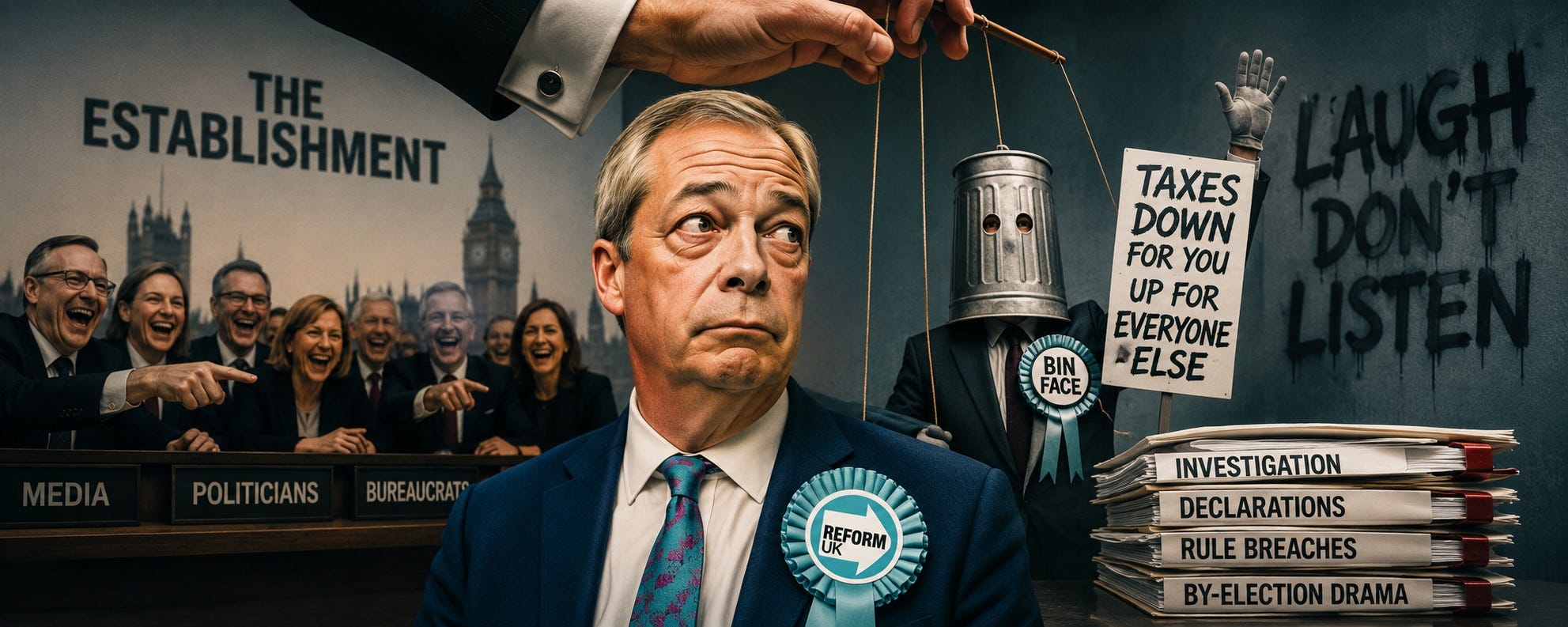
The Politics of Ridicule
Political careers end in death or failure. This is a consequence of what the Greeks called hubris or the assumption of Godlike status. We use it to mean an ego that blinds you to common sense.
This week, hostilities resumed in the Strait of Hormuz. Trump is trapped in a war he cannot win with an enemy that relishes being proved right about the nature of the US. Having come to power promising no more forever wars, Trump is digging in for a conflict that has already gone on too long.
Back home, Nigel Farage’s opponents hope he also meets a nemesis of his own making. Having refused to play by the establishment rules, he challenged them to a duel in Clacton-on-Sea. They refuse to fight. What little attention is paid to the 13 August by-election is reserved for a BBC scriptwriter with a bin on his head.
Farage’s supporters claim he is a man of conviction, willing to challenge popular opinion in the pursuit of what is right. He believes the strength of an argument will win over the public in time. Yet his reaction to the questioning of his financial affairs is straight out of the deny, downplay and distract playbook, which is eroding our remaining faith in politicians.
The challenge for an outsider with big ideas is that the establishment will tie you down with their petty rules. You can fight them from the outside but to beat them you must join them.
Farage was under investigation by the Parliamentary Standards Committee for not declaring a £5 million gift. He faced a separate charge of receiving undisclosed security and social media support during the 2024 election. Back in January, he apologised and amended the records after being accused of 17 disclosure breaches. The current investigations will resume if Farage is re-elected.
This is a man playing fast and loose. He wants to appeal to the people and discredit the pettifogging rules of those determined to defeat him. At first he denied the money was politically motivated. Then he downplayed its purpose. Now he distracts by triggering a by-election and claiming it is a David and Goliath battle with the establishment.
Both the Conservatives and Labour have struggled to know how to deal with Farage. In Burnham, Labour believes it has found an answer to his populist appeal. In the by-election, the establishment has the age-old response to what it views as pompous self-regard. They laugh.
Who is the Establishment?
No politician claims to be part of the establishment. They are for the people, fighting the forces that hold them back. As a result, no one agrees who is the establishment.
For some, it’s private school, Oxbridge and the City. In this case, I am establishment, or was in an earlier life. Jon Harvey, the man in the bin, is an Oxford classicist, while Farage did not attend university. Graduation is the new class divide in Britain, but it does not make you the establishment.
When I say establishment, which I do a lot and not in a nice way, I mean political leaders, heads of the civil service, lobbyists and the legal and PR firms that advise them. I include sections of the media. The Department of Culture, Media and Sport will provide me a list.
The DCMS plans to force social media platforms to prioritise content from preferred outlets. As is a habit with this type of handwringing legislation, the law is passed first and those who fall foul of it are identified later. This gives Farage evidence for his claim that the state controls who can be heard.
Farage rails against the uniparty of Labour and the Conservatives and those who maintain them in power. He launched his re-election campaign claiming that if he loses, they win. He tries to merge personal danger, political persecution and parliamentary procedure into one anti-establishment story. He then attempts to connect this to Reform’s core campaign policies.
But the by-election is still a reaction to parliamentary procedure. If you are a man of big ideas then squabbling over technical details is demeaning. You cannot fight this the way you battle over immigration or EU membership.
One Good Joke
Trump’s America makes the ideal Orwellian opponent for the oppressive Iranian regime. The forever wars are the backdrop to shutting the internet, cutting subsidies, higher security spending and expanding the use of the death sentence. This is a black-and-white view of the world, where you are either dogmatist or dissenter.
Democracies differ in how they exercise control. Orwell’s totalitarian vision contrasts with the use of distraction and appetite in Brave New World. In it, Huxley imagined a population controlled by hyper-consumerism reinforced through psychological conditioning. This is much closer to what we experience today.
We live in a world of digital games and short-form video reels. We can have anything we want delivered to our doorsteps. We get our news from social media soundbites. We don’t read much anymore. In 2024, the Reading Agency described 35% of adults as lapsed readers, a trend that predates ChatGPT.
Farage flourishes in this world. He makes money from peddling influence, which is the only thing a practising politician has time to do. The way to win the influence game is with polarising content that attracts eyeballs and advertisers. Then you back that up with subscription services for ardent fans.
Farage calls this the entrepreneurial flair that is missing in many parliamentarians. People may admire that, but it neither justifies hiding his income nor lends support to his call for lower taxation.
Harvey taps into this with his one good gag. He says he’ll cut your taxes and raise everyone else’s. This is a joke at the expense of the electorate.
We tell pollsters we want a wealth tax and higher capital gains and inheritance taxes. We do not want an increase in income tax, national insurance or VAT. We demand more spending without having to pay for it. Binface’s manifesto delivers this.
This is the fourth time Harvey has stood against the leader of a right-wing party. The joke is that his comic policies about capping food prices are becoming real proposals for controlling supermarkets and energy companies.
Amid the melee of distorted data and disinformation that is modern politics, Farage is trying to make a serious point. Big ideas are his stock-in-trade. But parliamentary rules and his personal security don’t capture the public interest. Farage is not a sympathetic figure and people just don’t care.
Farage confuses supporters with a personal campaign disguised as a popular mission. Meanwhile, Andy Burnham enters the scene with his own brand of populism, which Labour hopes will counter the right-wing version.
Labour’s New Populism
Burnham is nominated by 379 of Labour’s 403 MPs. That’s enough to ensure there is no other candidate. He used the solo hustings to outline his ideas for insourcing the outsourced state, resetting the party culture and introducing regional devolution.
Throughout Europe, the left has searched for a model for how to deal with right-wing populism. To date, the best example has come from Denmark. The governing coalition is led by a third-term Social Democrat. She made the successful choice to scale back immigration to protect the welfare state.
Burnham has no intention of copying this while he has a sizeable majority. This may be Labour’s last chance to convince us that it deserves to govern alone. He is betting that his anti-Westminster rhetoric is more popular than Farage’s anti-immigration stance.
Farage struggles to contrast his willingness to face the electorate with Burnham’s refusal to call a general election. These are different issues. He would have faced re-election had Parliament suspended or expelled him. His appeal to the people is being presented by opponents as self-serving. They say Farage is trying to soften his inevitable punishment because MPs won’t want to trigger a second Clacton by-election.
Burnham may spout nonsense about 40 years of economic decline and blame it on non-existent British neoliberalism. But he promises growth in every postcode, which sounds inclusive. It will be impossible to prove either way, which makes it the ideal soundbite for today’s hollow political debate.
That debate helps to mask the ruthless pursuit of an agenda. The fastest-selling hardcover in the US explains how Trump does this. Regime Change explores how the second-term Trump administration uses every political rule and sharp practice. Both Farage and his establishment opponents understand that politics is the use of institutional power to embed an ideal.
Farage does not just want to be Prime Minister. He wants to repeal the ECHR. He wants to cut taxes and shrink the state. He wants to replace the top echelons of the civil service. He has recruited Tories who know how to do this.
Farage presents himself as a politician of consequential ideas. But his missteps allow the establishment to reduce him to procedural breaches, personal grievance and farce. His response has been to make those grievances the campaign. In doing so, he helps his opponents turn him from insurgent into punchline.
The establishment may not stop his re-election, but it hopes that mockery will deny him the credibility he needs for what comes next.


